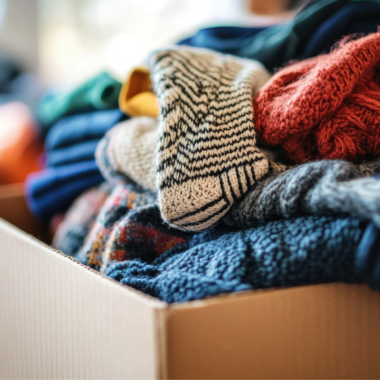
Buying used clothes wholesale in Europe can be a high-margin business — if you choose the right stock, understand what “quality” really means in second-hand, and build a repeatable resale workflow. This guide is built for real buyers: thrift store owners, online resellers, and businesses looking for reliable, sorted used clothing boxes shipped across the EU.
What you’ll get here: practical buying rules, quality & sorting expectations, logistics, and a resale playbook you can apply the same day your first box arrives.
Quick action:
✅ Browse available 20 kg boxes here → ALL BOXES
✅ Need help choosing the right category? Message us on WhatsApp
Who this guide is for (choose your path)
If you run a thrift store (brick & mortar)
Your goal is fast rotation and predictability. You’ll care most about:
- grades and category mix (to avoid too many unsellables)
- seasonality (what moves now)
- repeatable supply (to fill racks weekly)
Jump to: Quality Grades, Seasonality, Resale Workflow, Ordering Checklist
If you resell online (Vinted, eBay, marketplaces)
Your goal is margin per item and listing efficiency. You’ll care most about:
- categories with low return risk
- items that photograph well and sell fast
- avoiding time sinks (repairs, heavy defects)
Jump to: What to Expect in a 20 kg Box, Best Boxes for Each Model, Resale Workflow
If you’re buying wholesale for the first time
Your goal is not losing money on your first order. You’ll care most about:
- choosing the right category/grade
- understanding realistic expectations (brands, sizes, defects)
- a simple, repeatable process after delivery
Jump to: First Order Checklist, Red Flags, FAQ
The basics: what “used clothes wholesale” really means in the EU
Wholesale used clothing usually means buying in bulk — most commonly by weight (e.g., 20 kg / 25 kg boxes) — rather than per piece. In the EU, wholesale can serve:
- B2B: thrift stores, resellers, live sellers, small boutiques
- B2C: individual buyers who want a bulk box for personal resale or wardrobe
There are two key supply types:
Sorted vs unsorted — which one is right?
Unsorted (original collection)
- Highest uncertainty
- Requires your own sorting line, QC standards, time, space
- Can be profitable for sorters or businesses with trained staff
Sorted used clothing boxes (what we sell)
- Built for resellers who want predictability
- Faster to list/sell
- Better if your bottleneck is time, not sourcing
If you’re a store owner or online reseller, sorted boxes typically win because they reduce labor and stabilize your inventory planning.
What to realistically expect from a 20 kg box
Let’s talk about the part most suppliers avoid: expectations.
1) How many items are in a 20 kg box?
It depends on product type. A box of heavy winter jackets won’t have the same item count as a box of t-shirts.
Here are realistic ranges for a 20 kg box:
- Light items (t-shirts, tops, summer mix): ~45–80 items
- Medium items (hoodies, jeans, mixed everyday wear): ~30–55 items
- Heavy items (coats, thick knitwear, winter jackets): ~15–35 items
These are ranges — not guarantees — because each piece has a different weight.
2) Sizes: what does “mixed sizes” mean?
Second-hand wholesale is almost always mixed sizing. In practice:
- you’ll receive a variety (S–XL and beyond)
- the exact distribution varies by stream, season, and category
- kids categories typically have wider spread (age/size)
Reseller tip: build your listing workflow assuming size variety — don’t try to “optimize” sizes on the first order. Optimize category/grade first.
3) Brands: can anyone guarantee brand mix?
No serious supplier can guarantee specific brands inside weight-based second-hand boxes. What you can expect instead is:
- a consistent category definition (e.g., women’s autumn/winter mix)
- a grade/quality standard aligned with that category
- an honest description of typical outcomes
If your business model depends entirely on one brand — wholesale second-hand is the wrong sourcing method. If your model depends on sellable inventory with repeatable margin, it’s the right method.
Quality grades explained (Cream / Grade A / Mix) — and which one you should buy
Buyers often choose the wrong grade. The best grade is not “the highest one” — it’s the one that fits your resale model.
Cream (Top Selection)
Best for: premium resellers, boutiques, highest margin-per-item models
What to expect: strong overall presentation, fewer defects, higher resale potential
Trade-off: higher cost per kg; you need a pricing strategy that captures value
Grade A / First Grade (Everyday resale)
Best for: thrift stores, online resellers who want scale and stable rotation
What to expect: solid wearable mix, minor issues possible, good bulk economics
Trade-off: you’ll do some quick QC and occasional minor fixes
Mix / Budget categories
Best for: experienced resellers who can process fast, live sales, value racks
What to expect: wider quality spread, more time in QC
Trade-off: you must be efficient — profit is in speed, not perfection
Choose the right box: the practical table
| Your model | Best starting choice | Why it works | Risk to manage |
|---|---|---|---|
| First-time buyer | Grade A (focused category) | predictable, easiest learning curve | don’t overpay / don’t chase brands |
| Vinted / online resale | Cream or Grade A (women / kids) | good photos + strong rotation | time per listing |
| Thrift store | Grade A + seasonal categories | stable racks and weekly restock | season timing |
| Live sales | Mix / fast-moving categories | speed and impulse buys | QC discipline |
Want help choosing a box for your exact model? WhatsApp us
Seasonality: the simplest way to avoid dead stock
Seasonality is not a detail — it’s often the difference between profit and inventory that doesn’t move.
Spring/Summer (SS)
Moves fast when:
- your listings match current weather
- you price for volume and quick rotation
Best categories: light tops, dresses, sportswear, kids, mixed casual
Autumn/Winter (AW)
Moves fast when:
- you buy early (before peak demand)
- you’re ready for heavier items (storage + steaming)
Best categories: coats, knitwear, hoodies, jeans, boots (if you sell footwear)
Rule of thumb:
If you’re buying for AW, start building inventory before the season peaks. If you wait until everyone buys winter stock, you’ll sell later and slower.
How we source and sort (trust, but verify)
There are many used clothing wholesalers in Europe. What separates reliable supply from random boxes is sorting and quality control.
At SortedClothes.eu, we focus on:
- sourcing from Scandinavian and Western European streams
- in-house sorting with consistent category definitions
- building boxes only after your order to keep the process controlled
Our “non-negotiables” (QC principles)
- weight is verified per box
- categories follow a defined scope (women/men/kids, season, grade)
- obvious unsellables are filtered out depending on grade
- packing is designed for transport and resale handling
👉 Shop current stock → ALL BOXES
Shipping & logistics across the EU (what matters in real life)
Wholesale buyers care about three things: cost, speed, reliability.
What affects shipping time?
- destination country/region
- courier network load
- weather / seasonal peaks
- delivery address type (business vs residential)
Tracking and delivery
You should always be able to:
- receive a tracking number
- know who the courier is
- plan your receiving workflow
For current delivery options and payment methods, see: Shipping & Payment
Storage & handling after delivery
Before your first order arrives, prepare:
- a clean receiving area
- 2–4 large containers/bins for category sorting
- a simple defect-handling station (lint roller, fabric shaver, needle/thread, steamer)
This setup costs little and saves hours.
The resale playbook: what to do after your box arrives (step-by-step)
Most buyers lose margin not at purchase — but in poor processing. Here’s a workflow that works for both stores and online resellers.
Step 1: Receiving + fast check (15–30 minutes)
Do this immediately:
- confirm box condition and weight label
- do a quick top-layer inspection
- note anything unusual (damage, wet packaging)
Step 2: Rapid QC sorting (45–120 minutes)
Sort into 4 piles:
- Ready to sell (A)
- Needs quick refresh (B) — steaming, lint, minor fix
- Repair/decision (C) — only if it’s worth your time
- Reject/low value (D) — bundle sale, clearance, donate, recycling stream
Important: Don’t overinvest in C. Most beginners waste time here.
Step 3: Refresh station (batch it)
Batch work is everything:
- steam 10–20 items at once
- lint-roll in batches
- photograph in the same setup
Step 4: Listing workflow (online resale)
Use a repeatable template:
- title: brand + item type + key feature
- 4–8 photos (front/back/tag/defect close-up)
- 1 sentence condition statement
- shipping next-day rule (improves ratings + repeat sales)
Step 5: Pricing (simple model)
Pick one:
- fast cashflow: lower price, rapid rotation
- max margin: higher price, slower rotation
Don’t mix models in the same account unless you know what you’re doing — it confuses customers and kills velocity.
Step 6: Reorder logic (build a supply system)
A system beats luck:
- track sell-through by category
- reorder what moves
- change only one variable at a time (grade or season or demographic)
First order checklist (print this)
Before you buy:
- ✅ Choose your resale model (store / online / live)
- ✅ Choose one focused category (avoid “everything mixed” as a beginner)
- ✅ Decide your pricing model (fast rotation vs max margin)
- ✅ Prepare receiving & QC station
- ✅ Understand realistic expectations (brands, sizes, defects)
- ✅ Plan your first 7 days: receiving → QC → listing → first sales
After you buy:
- ✅ Track processing time per item
- ✅ Track sell-through by category
- ✅ Decide whether to reorder same category or test one new variable
Ready to start? Browse 20 kg boxes → ALL BOXES
Supplier red flags (how to avoid costly mistakes)
Avoid suppliers who:
- promise specific luxury brands in weight-based boxes
- avoid clear grade definitions
- have no shipping transparency (no tracking, no courier details)
- can’t show consistent category structure
- have vague terms like “premium mix” without scope
- pressure you with “only today” deals and no documentation
A good supplier is boring: clear categories, clear process, consistent outcomes.
Common mistakes buyers make (and how to avoid them)
- Buying “for brands” instead of for sellability
- Ordering the wrong season because it’s “available now”
- Over-sorting and spending too much labor per item
- No QC workflow → slow listing → dead cashflow
- Pricing too high on average items (slows rotation)
- No clearance strategy for low-value pieces
- Switching categories every order (no learning loop)
- No storage/photography setup (time explodes)
- Underestimating shipping + processing costs
- Not tracking what actually sells
FAQ — Used clothes wholesale in Europe
What’s the best box for beginners?
Start with Grade A / First Grade in a focused category (e.g., women’s mix or kids). It’s the best balance of predictability and margin.
Do you guarantee specific brands?
No — weight-based second-hand boxes cannot guarantee brand mix. We guarantee category scope + grade standard + verified weight, and we support you in choosing the right box.
How do I minimize unsellable items?
Choose the right grade for your model, process quickly, and have a clearance strategy. Most “waste” comes from poor workflow, not from the box itself.
How fast can I start reselling after delivery?
If your setup is ready, you can:
- QC the same day
- list your first items within 24–48 hours
Speed is a competitive advantage in resale.
Is wholesale used clothing better for B2B or B2C?
It works for both, but expectations differ. B2B buyers usually prioritize repeatable supply and ROI; B2C buyers often want a “surprise box.” For business results, treat it as inventory, not a mystery box.
Which category sells fastest in Europe?
It depends on season and channel, but generally women’s everyday wear and kids rotate quickly due to broad demand and frequent wardrobe turnover.
Ready to buy? Start here
If you want predictable inventory and a resale process you can repeat, start with a category that matches your model.
👉 Shop sorted used clothing boxes (20 kg) → ALL BOXES
👉 Not sure which one fits? WhatsApp us
👉 Want shipping/payment details first? See Shipping & Payment